February 28th, 2026
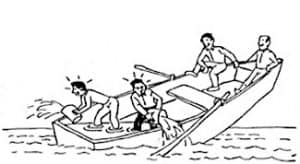
“Sure glad the hole isn’t on our end!”
The instant formal government is abolished, society begins to act. A general association takes place, and common interest produces common security.
Thomas Paine, The Rights of Man
I recently participated in Redfin’s Great American Home Search. This was a competition for a million-dollar house based on a Super Bowl commercial called “America Needs Neighbors Like You.” It features a rendition, sung by Lady Gaga, of “Won’t You Be My Neighbor?”
It’s ironic that a video about being more neighborly — that is, helping each other — was the centerpiece of a contest with only one winner. Some people tried to collaborate online and some even posted the answers, and others felt this was unfair to those who had figured out the answers for themselves.
I played the game with my family, and the experience has opened up a discussion about cooperation vs. fairness. Why was it fair to team up in small groups but not to work together online in a group that anyone could join?
The answer could help our country be more neighborly. That could be the real prize. We all want a place to call home. How on Earth do we find it?
Divided We Fall
I found the video really touching. I watched it repeatedly and cried every time. The game gave my family something to bond over, so I appreciate that too.
But the video was a commercial, a brief, highly-orchestrated production designed for a specific outcome. What was the real intention behind it, and what was the game designed to do?
Redfin surely knew that people would post the answers. They could have narrowed the pool of winning candidates with each step, not allowing others to join later and catch up. It’s possible that Redfin allowed this to happen so that word would spread about the game, thereby publicizing Redfin in the process.
Ultimately, however, many characterized the contest as “a lottery disguised as a game.” Even though in theory, the first person with the correct final answer (and if tied, the one before it, etc.) was the winner, the rules said Redfin could reject them for basically whatever reason they wanted:
The Potential Winner may be subject to disqualification if Sponsor finds that Potential Winner’s conduct or public content is reasonably expected to cause harm to Redfin’s brand, reputation, or business relationships and is inconsistent with the positive goodwill to which Sponsor wishes to associate.
It’s understandable that Redfin would want to vet the potential winner. They obviously put a tremendous amount of work into creating the whole thing, so to some extent they have a right to do so.
However, some claim that without some kind transparency or independent oversight, Redfin could have basically picked whoever they thought would look good. Once the winner was announced, many thought they had done just that.
If the game had been designed more cooperatively, with players having a say in how it was set up, there could have been a public way to record who submitted what answers and when. The effect of sharing answers could have been minimized. But was fairness really the point?
United We Stand
The question of fairness assumes that life is a competition. But what is happening in this country and around the world shows us that it is not. Competition is the opposite of cooperation. A lack of cooperation, of neighborliness, is what is bringing us all down.
Cooperation is not the same as Communism or Socialism. Those are systems where government makes the rules. In this competition, the rules were made by Redfin. Consequently, that’s mostly, it seems, who the game was designed to benefit.
If the contest had been set up to benefit everyone, the prize could have been giving a million people one dollar instead of one person a million dollars. Alternatively, the million dollars could have been invested and every player made a shareholder. Or the money could have gone to charity.
There are probably better ideas. The point is that together, we could have come up with them. Then it would have been a game with one winner: everyone.
In politics, the same applies. It’s not the system that matters; there are always ways to cheat. What matters is whether everyone cares about everyone else. If you don’t have that, the system will fail every time. Sooner or later, it will be dominated by cheaters.
In the game of planetary survival, there cannot be winners and losers: it’s all of us or nothing. We have to cooperate with each other and the rest of nature because we are all in the same boat.
Cooperation has, until recently, been what makes us human. It’s how we have been able to overrun the planet. The unraveling of the social fabric — the fact that today, nearly everyone is, to some extent, only looking out for themselves — is why things are falling apart.
To take a simple example: it’s easier, in the short run, to throw your trash on the street, in the woods, or in the ocean. But it soon comes back to haunt us.
Like I said, cooperation means caring. It’s not just something you do, say, or believe; it’s something you feel. Today, we have gotten so far from caring that some think it’s actually dangerous. They say it makes you foolish, i.e., a sucker.
Was it foolish for people to post their answers online? Is it really smarter to keep the answers to yourself? On this ship, who are the fools?
Mass collaboration has been termed Wikinomics. It certainly has its dangers, many of which fall under what has been termed the “tragedy of the commons.” The idea is that if you invite everyone to work together, some will always cheat and ruin it for everyone else.
Fortunately, that’s a myth. Humans evolved to be cooperative, a.k.a., prosocial. With this came our ability to control for cheaters. Some say the human brain is big precisely to be able to judge who can and cannot be trusted.
People who care — who cooperate — aren’t foolish. It’s those who don’t team up who are. As this contest clearly shows, when 250,000 people compete against each other, all playing by one company’s rules, who do you think will be the winner?
The word eco-, as in ecology and economy, means “house.” The day we stop competing for our house is the day we find home.